

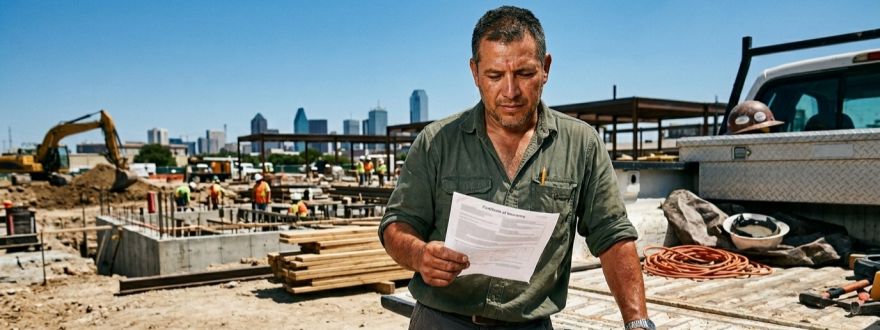
Before a Texas contractor can sign a commercial lease, execute a client contract, or get on a general contractor's approved vendor list, one document gets requested every time: a certificate of insurance showing active liability coverage. That single piece of paper is why contractor liability insurance is not optional in this market regardless of what Texas state law technically says.
Contractor liability insurance, formally called general liability insurance for contractors, covers the core risks that every contractor faces on the job: a third-party injury, damage to a client's property, and claims that arise after a project is completed. It is the non-negotiable baseline coverage that every other policy in a contractor's program is built on top of.
This guide focuses specifically on what contractor liability insurance costs in Texas, what it covers, what drives the rate, and what Dallas contractors can expect to pay based on their trade. For a breakdown of the full insurance program including workers' comp, commercial auto, builder's risk, and surety bonds, see the complete Texas contractor insurance cost guide.
How Much Does Contractor Liability Insurance Cost in Texas?
Contractor liability insurance in Texas starts at approximately $83 per month for a solo general contractor with minimal exposure and can exceed $665 per month for a small roofing or demolition operation with employees. Most Texas contractors with one to four employees pay between $200 and $420 per month for standard $1 million per occurrence / $2 million aggregate general liability coverage.
Most small Texas contractors pay between $1,000 and $5,000 per year for general liability insurance, though premiums can exceed $7,500 annually for higher-risk trades such as roofing, demolition, and excavation. Trade classification, employee count, payroll, claims history, and coverage limits all affect the final cost.
Texas contractor liability insurance cost benchmarks (1-4 employees, $1M/$2M limits):
-
Lowest-rated trades (interior design, surveying, lawn care, pest control): $137 to $215 per month
-
Lower-mid trades (painting, handyman, carpentry, fence installation): $200 to $265 per month
-
Mid-range trades (remodeling, flooring, drywall, siding): $265 to $345 per month
-
Higher-rated trades (plumbing, HVAC, electrical, general contractors): $360 to $430 per month
-
Highest-rated trades (roofing, demolition, excavation, asbestos abatement): $540 to $665 per month
Dallas-area contractors pay approximately 10 to 15 percent more than the statewide average due to higher urban density, a more active plaintiff's bar in Dallas County, and the larger commercial contract requirements of the DFW market.
What Is Contractor Liability Insurance and What Does It Cover?
Contractor liability insurance is a general liability insurance policy written specifically for businesses that perform physical work at client locations or on job sites. It protects the contracting business from financial loss when third parties, meaning people outside the business, suffer bodily injury or property damage connected to the contractor's work.
Third-Party Bodily Injury
If a client, property owner, or bystander is injured because of your work or your crew's activities, your liability policy covers their medical expenses, lost wages, pain and suffering damages, and your legal defense if they file a lawsuit. Slip-and-fall incidents on active job sites, injuries from falling materials, and accidents involving your equipment are all covered under this provision.
Third-Party Property Damage
If your crew damages a client's property during a job, such as breaking a window during a remodel, causing water damage while working on plumbing, or cracking a floor during equipment installation, the liability policy covers the repair or replacement cost and your legal defense. This is one of the most frequently triggered coverage categories for Texas contractors.
Products and Completed Operations
This coverage extends your liability protection to claims that arise after a project is finished. If a construction defect, a faulty installation, or a material failure causes damage or injury months or even years after your crew left the job site, completed operations coverage responds. Texas law allows construction defect claims to be filed for up to ten years after project completion, making this provision critical for any Texas contractor doing structural or systems work.
Personal and Advertising Injury
Covers claims of slander, libel, false advertising, or copyright infringement made against your business. Less commonly triggered for trades-based contractors but standard across all GL policies.
Legal Defense Costs
One of the most underappreciated aspects of contractor liability insurance is that it pays your legal defense costs in addition to any settlement or judgment, and defense costs in Texas contractor disputes are substantial. A contested construction defect claim in Dallas regularly produces $75,000 to $150,000 in attorney fees before it resolves, often exceeding the underlying damages. The liability policy covers all of those costs up to your limit.
What Contractor Liability Insurance Does Not Cover
Contractor liability insurance is not an all-in-one policy. Understanding what it excludes is just as important as understanding what it covers, because gaps in coverage are where claim denials happen.
-
Your own employees' injuries: Workers' compensation covers employee injuries. GL excludes them entirely. In Texas, where workers' comp is optional, a contractor without WC coverage who opts out loses significant legal protections if an employee is injured and sues.
-
Damage to your own tools and equipment: Your tools, vehicles, and equipment require separate coverage through a commercial property policy, an inland marine policy, or a tools and equipment endorsement. GL only covers damage you cause to others.
-
Professional mistakes and design errors: If you design or specify something that fails, that is a professional liability claim. GL does not cover it. Design-build contractors, engineers, and HVAC contractors who do system design need professional liability alongside GL.
-
Vehicle accidents: Accidents involving your work trucks or vans are covered by commercial auto insurance, not GL. Texas requires commercial auto coverage for every vehicle used for business purposes.
-
Intentional damage or fraud: GL excludes any damage caused intentionally by you or your employees.
-
Employee claims (EPLI): Wrongful termination, discrimination, or harassment claims from employees require Employment Practices Liability Insurance. GL does not cover these.
These exclusions are why most commercial contracts in Texas require contractors to carry GL alongside workers' comp and commercial auto as a complete minimum program, not as standalone coverage.
Contractor Liability Insurance Cost by Trade in Texas (2026)
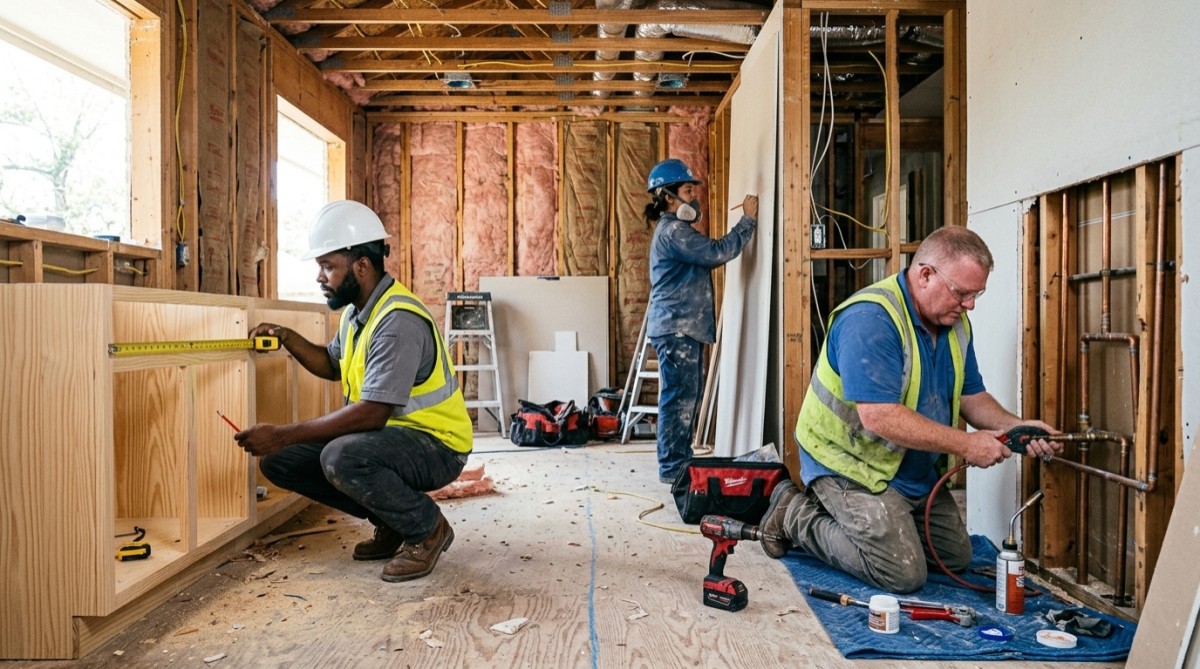
Your contracting trade is the second most powerful pricing variable after employee count. Insurers assign every trade to a classification code based on the physical risk of the work, the historical frequency of claims in that trade nationally, and the typical severity of those claims when they occur. The figures below reflect a one-to-four-person Texas operation with $1M/$2M standard limits.
Lowest-Rated Trades
-
Interior designers: $137 to $165 per month. Limited physical exposure at client locations; most work is advisory.
-
Architecture and engineering firms: $160 to $200 per month. GL reflects limited on-site physical risk; professional liability is the primary exposure for these trades.
-
Land surveyors: $165 to $200 per month.
-
Lawn care and grounds maintenance: $195 to $215 per month.
-
Pest control operators: $185 to $210 per month.
-
Painting contractors: $200 to $222 per month. One of the most common trades at the lower end of the Texas contractor liability market.
-
Irrigation and sprinkler contractors: $210 to $225 per month.
-
Handyman services: $215 to $230 per month.
Mid-Range Trades
-
Carpentry and millwork: $245 to $265 per month.
-
Fence installation: $245 to $265 per month.
-
Insulation contractors: $255 to $275 per month.
-
Tile and flooring installation: $270 to $295 per month.
-
Drywall and plastering: $285 to $310 per month.
-
Door and window installation: $265 to $290 per month.
-
Remodeling contractors: $325 to $345 per month. Water intrusion and structural disturbance during remodels in older North Texas homes drives GL rates above finish trades.
-
Restoration contractors: $315 to $340 per month. Fire and water restoration work carries elevated claim frequency in Dallas due to the frequency of severe weather events.
Higher-Rated Trades
-
Plumbing contractors: $360 to $385 per month. Water damage is one of the most severe and common GL claim categories in Texas. A single pipe failure during installation can cause $40,000 to $200,000 in property damage.
-
Paving and asphalt contractors: $365 to $390 per month.
-
HVAC contractors: $375 to $400 per month. TDLR-licensed in Texas. System design errors and refrigerant-related property damage are primary GL drivers.
-
Electricians: $375 to $405 per month. Electrocution risk, fire from faulty wiring, and property damage from electrical work are the key GL exposures. TDLR licensing requirement applies.
-
Concrete contractors: $395 to $425 per month.
-
Masonry contractors: $385 to $415 per month.
-
General contractors: $400 to $430 per month for small residential GCs. Commercial GCs with active subcontractor networks and higher project values pay more based on annual revenue.
Highest-Rated Trades
-
Roofing contractors: $640 to $665 per month. The highest-rated contractor trade for GL in the United States. Fall risk, North Texas hail damage claims, and the frequency of property damage disputes on roofing projects combine to create the most expensive GL classification in the contractor category.
-
Demolition contractors: $615 to $640 per month. Structural risk and third-party property exposure from demolition work in dense Dallas neighborhoods drives rates near roofing levels.
-
Excavation and earthwork: $545 to $570 per month. Underground utility damage is the primary GL exposure for excavation work in the Dallas metro, where buried infrastructure density is high.
-
Asbestos and hazmat abatement: $575 to $600 per month.
-
Fire sprinkler contractors: $515 to $540 per month.
-
Utility contractors: $565 to $590 per month.
How Employee Count Affects Contractor Liability Insurance Cost
Employee count produces the largest pricing jump in contractor GL of any variable in the rating formula. The exposure logic is straightforward: more workers means more simultaneous job sites, more tools in use, more customer property at risk, and more chances for a covered incident to occur.
-
Solo contractor (zero employees): 75 to 80 percent below the 1-4 employee benchmark for most trades. A solo painter pays approximately $40 to $55 per month. A solo general contractor may pay $83 to $100 per month. A solo roofer pays $130 to $165 per month.
-
1 to 4 employees: The benchmark tier for this guide. Adding a single employee more than quadruples premiums in most contractor classifications. This jump is larger in construction than in any other industry.
-
5 to 9 employees: Approximately 2.2 times the 1-4 employee rate. A general contractor moving from 4 to 5 employees should budget for a GL increase of $400 to $600 per month at renewal depending on trade.
-
10 to 19 employees: 4 to 5 times the solo benchmark. Mid-size Texas contractors at this headcount pay $3,000 to $8,000 per month for GL depending on trade.
-
20 to 49 employees: The highest-rated trades reach $7,800 per month or more. Large roofing and demolition operations in Texas regularly pay $80,000 to $100,000 per year in GL premiums alone.
Contractor Liability Insurance Coverage Limits and What They Mean
Choosing the right coverage limits is not a cost decision. It is a contract and risk decision. Your coverage limit determines the maximum your insurer will pay per incident (per occurrence limit) and in total across all claims during the policy year (aggregate limit). Any amount above your limit is your personal exposure.
Per Occurrence vs. Aggregate Limits
The per occurrence limit is the most any single claim will pay. The aggregate limit is the most the policy will pay across all claims combined in the policy year. A $1M/$2M policy pays up to $1 million on any one claim and up to $2 million total across the year.
In Texas, where a single contractor claim can produce a $400,000 to $700,000 judgment in property damage or bodily injury, the per occurrence limit matters more than the aggregate for most small contractors. Choose a per occurrence limit that matches your largest single job value, not your monthly revenue.
Standard Limit Options and Cost Premium
-
$300,000 per occurrence / $600,000 aggregate: Approximately 30 to 40 percent below the $1M/$2M rate. Rarely sufficient for commercial clients in Dallas. Most landlords and commercial GCs will not accept limits below $1M.
-
$500,000 per occurrence / $1M aggregate: 15 to 25 percent below the $1M/$2M standard. Still below what most Dallas commercial contracts require.
-
$1M per occurrence / $2M aggregate: The Texas commercial standard. Required by virtually all commercial leases, client contracts, and licensing boards. The benchmark for all pricing in this guide.
-
$2M per occurrence / $4M aggregate: 20 to 35 percent above the $1M/$2M rate. Required on larger commercial projects, government contracts, and by many general contractors for subcontractors working on projects above $500,000.
-
$1M primary plus $1M commercial umbrella: Often cheaper than a $2M/$4M primary policy while reaching the same effective limit per occurrence. A $1M umbrella typically costs $800 to $2,000 per year for most contractor classifications.
For Dallas contractors where commercial clients require $2M per occurrence, pairing a $1M primary GL with a commercial umbrella policy is almost always the more economical structure.
Why One Texas Contractor Pays $800 and Another Pays $4,000
-
Trade classification
-
Annual payroll
-
Subcontractor costs
-
Claims history
-
Years in business
-
Coverage limits
-
Dallas vs rural Texas operations
-
Certificates of insurance and additional insured requirements
Additional Insured Endorsements: What They Are and What They Cost
When a client, general contractor, or property owner asks to be named as an additional insured on your contractor liability policy, they are asking for direct access to your coverage for claims arising from your work. This is a standard requirement in Dallas commercial construction and gives the additional insured the right to file claims directly against your insurer.
Most GL policies include a blanket additional insured endorsement that automatically extends coverage to any entity required by contract. Policies without blanket coverage require a specific endorsement naming each additional insured, which may carry a per-endorsement charge of $25 to $150 depending on the carrier.
For Dallas contractors working on multiple commercial projects simultaneously, confirming your policy includes blanket additional insured coverage avoids the cost and delay of individual endorsements for each project.
Why Completed Operations Coverage Matters for Texas Contractors
Completed operations coverage is the portion of your contractor liability policy that protects you from claims arising after a project is finished. It is included in most standard GL policies but is increasingly being written with sublimits, exclusions, or separate deductibles on certain policy forms for high-risk trades.
Texas is one of the most significant states for completed operations exposure. The Texas statute of repose for construction defects allows claims to be filed for up to ten years after project completion, according to provisions under Chapter 16 of the Texas Civil Practice and Remedies Code. A roofing contractor who completed a job in 2021 can face a property damage claim in 2030 under that window.
When reviewing any contractor GL policy, confirm:
-
Completed operations coverage is included and not separately sublimited
-
The retroactive date for completed operations matches the start of your business operations
-
There is no separate, higher deductible applied specifically to completed operations claims
-
The policy form does not contain a construction defect exclusion that eliminates completed operations for residential work
Why Texas Contractor Liability Insurance Costs More Than Most States
Dallas Litigation Environment
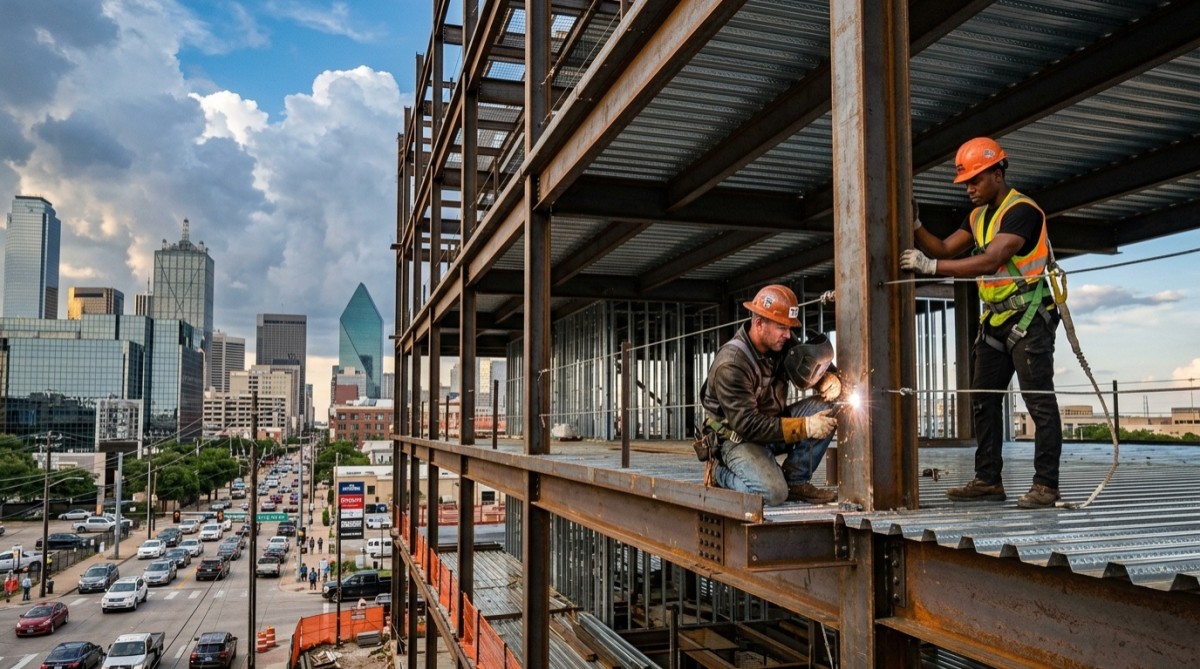
Dallas County is one of the most active jurisdictions in the United States for construction liability litigation. Defense costs in contested GL claims in North Texas regularly exceed $75,000 to $100,000 before a case resolves, often exceeding the underlying damages in smaller disputes. That litigation climate is built into base rates for all Texas contractor GL classifications.
North Texas Hail and Weather Exposure
Dallas averages five to eight significant hail events per year. Severe weather during active construction is a primary trigger for property damage GL claims in this market. Hail damage to neighboring properties during roofing work, wind damage to materials during construction, and flooding at active job sites are all covered GL events that occur more frequently in North Texas than in most U.S. markets.
TDLR Licensing Standards
The Texas Department of Licensing and Regulation oversees electrical, plumbing, HVAC, and other licensed trades. When a contractor holds a TDLR license, they accept a higher standard of professional care. Courts and clients hold licensed contractors to that elevated standard, which directly increases the exposure against which GL defends. TDLR-licensed trades price higher in the GL market than their unlicensed counterparts for precisely this reason.
Urban Density and Commercial Project Scale
Dallas commercial projects involve higher-value properties, more complex construction sequences, and denser surrounding environments than most U.S. markets. An excavation contractor in Uptown Dallas faces a fundamentally different exposure than the same trade operating in a rural Texas county. Insurers price that urban density into Dallas-area contractor GL rates at the upper end of the Texas range.
Is Contractor Liability Insurance Required in Texas?
Texas does not impose a universal statutory requirement on contractors to carry general liability insurance. The Texas Department of Insurance does not mandate a specific GL minimum for all contracting work. However, the practical reality for any contractor operating in the Dallas commercial market means liability insurance is effectively mandatory through four channels:
-
Commercial lease requirements: Nearly every commercial landlord in Dallas requires tenants who do physical work to provide proof of liability coverage before possession. Minimum limits of $1M per occurrence are the standard requirement.
-
Client contract requirements: Commercial clients, developers, and project owners specify insurance requirements in every subcontract. Operating without the required limits means disqualification from the bid, not just a COI request.
-
TDLR licensing requirements: Several Texas trades must carry minimum liability insurance or post a surety bond as a condition of holding their TDLR license. An electrical contractor who lets GL lapse risks license suspension.
-
General contractor requirements: General contractors in Texas contractually require all subcontractors to carry GL and name the GC as an additional insured. A subcontractor without liability coverage cannot work on most commercial projects in Dallas.
How to Get an Accurate Contractor Liability Insurance Quote in Texas
The information you provide determines the accuracy of any GL quote you receive. Contractors who receive quotes significantly higher than the benchmarks in this guide are typically either misclassified, have a claims history affecting their rate, or received a quote from a carrier without appetite for their specific trade.
Information needed for an accurate GL quote:
-
Primary trade classification: Your main contracting work. If you do multiple trades, the highest-risk classification typically governs the GL rate.
-
Estimated annual gross revenue: Many carrier forms use revenue as a secondary rating base alongside payroll.
-
Number of employees and subcontractors: Both affect the rating base. Confirmed subcontractor COIs reduce your audit exposure.
-
Business address: Dallas and urban DFW prices higher than suburban or rural Texas addresses for the same trade.
-
Prior claims history: Any GL claims in the past five years affect your rate and may affect carrier availability.
-
Required limits and endorsements: Confirm the per occurrence and aggregate limits required by your current contracts before requesting a quote.
An independent broker running your profile against multiple markets consistently finds better rates than going direct to a single carrier, particularly for higher-risk trades like roofing, excavation, and demolition where standard market availability is limited.
How to Lower Your Contractor Liability Insurance Premium in Texas
-
Require COIs from all subcontractors. Every uninsured subcontractor working under your supervision is an exposure that gets loaded into your GL audit. Requiring subs to carry their own GL and provide COIs removes that exposure from your rating base and reduces your audit premium at year-end.
-
Maintain a clean loss run. Three consecutive years without a paid GL claim typically earns a 15 to 25 percent renewal credit. Safety documentation, incident logs, and toolbox talks create the paper trail that supports that clean record.
-
Classify your work accurately. Carriers rate on the riskiest work you accept. If your business has shifted toward lower-risk work, your classification may be adjustable. Document any change in your primary trade activity.
-
Use a commercial umbrella instead of higher primary limits. For contracts requiring $2M per occurrence, a $1M primary plus a $1M umbrella is consistently cheaper than buying a $2M primary directly.
-
Compare markets at every renewal. Texas contractor GL pricing shifts annually. Carrier appetites for specific trades change based on loss ratios, reinsurance conditions, and program availability. An independent broker running your renewal against five or six markets consistently finds lower rates than auto-renewal with the same carrier.
Why Dallas Contractors Get Liability Insurance Through Thumann Agency
Thumann Agency has been placing contractor liability insurance for Dallas trades since 1996. As an independent broker working with 80+ carriers, we compare the market for your trade and find coverage that satisfies your contracts, protects your crew, and does not carry hidden exclusions that surface only when a claim is filed.
-
80+ carriers on every quote. Higher-risk trades like roofing, demolition, and excavation are limited markets in Texas. We have access to admitted carriers, surplus lines markets, and trade-specific programs that direct writers and single-carrier agents cannot offer.
-
Same-day Certificates of Insurance. Dallas commercial contracts do not wait. When a COI is needed before a deadline, we handle it the same day.
-
Completed operations review. We review every policy form for completed operations exclusions, sublimits, and deductible structures before recommending a carrier. This is where most contractor GL gaps are found.
-
Annual renewal re-quote. We re-quote your GL at every renewal against the current market. Staying with the same carrier year after year without reviewing alternatives consistently results in overpayment.
-
Dedicated Risk Advisor. Every Thumann Agency client works with one person who understands your trade, your contracts, and your history. Not a call center, not a rotating rep.

Frequently Asked Questions
How much does contractor liability insurance cost per month in Texas?
Most Texas contractors with one to four employees pay between $200 and $430 per month for standard $1M/$2M general liability coverage. Solo contractors start as low as $83 per month. Roofing and demolition contractors with employees pay $640 to $665 per month or more. Dallas-area contractors pay 10 to 15 percent above the statewide average for the same trade and employee count.
What does contractor liability insurance cover?
Third-party bodily injury, third-party property damage, completed operations claims after a project finishes, and personal and advertising injury. It also pays legal defense costs in full, which frequently exceed the underlying claim value in Texas construction disputes.
Is contractor liability insurance the same as general liability insurance?
Yes. Contractor liability insurance is a general liability (GL) policy written for contracting businesses. The term 'contractor liability insurance' is commonly used in the industry to distinguish it from GL for retail, hospitality, or service businesses, but the underlying policy form is a commercial general liability policy with construction-specific endorsements.
What is the minimum liability insurance a contractor needs in Texas?
Texas state law does not set a universal minimum, but the Texas Department of Insurance provides guidance on commercial insurance requirements by trade. The practical minimum for most Dallas commercial work is $1 million per occurrence and $2 million aggregate. TDLR-licensed trades must maintain the minimum required by their licensing board as a condition of active licensure.
Does contractor liability insurance cover subcontractors?
Your GL policy may or may not cover your subcontractors' work depending on the policy language. Most commercial GL policies exclude subcontractors' operations unless they are specifically listed or the policy includes a blanket subcontractor endorsement. The safest practice is to require all subcontractors to carry their own GL coverage and provide COIs, which removes their exposure from your policy entirely and protects you if a claim arises from their work.
How quickly can I get contractor liability insurance in Texas?
Most standard contractor GL policies can be issued within one to two business days. Higher-risk trades like roofing, demolition, and asbestos abatement may require a few additional days for underwriting review. If you have an urgent need, such as a contract award or permit requirement, Thumann Agency can often expedite the process and issue a same-day COI once the policy is bound.
Get a Contractor Liability Insurance Quote in Texas
Contractor liability insurance is the foundation of your business in the Texas market. Without it, you cannot sign a commercial lease, execute most client contracts, work as a subcontractor on commercial projects, or maintain your TDLR license. Getting it right the first time means understanding your trade's rate, your contract requirements, and which policy form actually covers the work you do.
Thumann Agency has placed contractor liability insurance for Dallas trades since 1996. Request a quote online or call (972) 991-9100. Same-day COIs. Full coverage review at no cost.
Last Updated: May 23, 2026
Author: Lauren Thumann Director of Marketing.

This post is for informational purposes only. For questions specific to your policy or situation, please contact the Thumann Agency directly. For regulatory questions, contact TDI at www.tdi.texas.gov.