Contractor Liability Insurance, Dallas TX

General Liability Insurance for Dallas Contractors and Tradespeople
A homeowner trips over your extension cord during a kitchen renovation and breaks their wrist. A water heater connection fails two months after installation and floods a finished basement. General liability insurance is what stands between your business and the full financial weight of those claims.
We've been helping protect Dallas contractors and tradespeople since 1996. As an independent broker representing 80+ carriers, we build liability programs around your trade, your projects, and your contract requirements. Need broader protection? Explore our Contractors Insurance Dallas, TX programs.
Start Your Contractor Liability Insurance Quote | Call (972) 991-9100
Why Dallas Contractors Choose Thumann Agency
-
80+ Carrier Options so your GL gets priced across carriers that actually specialize in contractor risk, not a single company's standard rate
-
Same-Day COI Delivery with correct limits, additional insured language, and certificate holder wording for GCs, lenders, and municipalities
-
Coverage Structured for Your Trade GL with completed operations, correct classification codes, and limits that match your actual bid requirements
-
Dallas Construction Market Specialists, Since 1996 who understand the $1M/$2M standard, TDLR licensing requirements, and what your GC expects on the certificate
-
Annual Policy Reviews Included so your limits, classification codes, and payroll basis stay current as your revenue and scope grow
Why Dallas Contractors Trust Us
Thumann Agency has earned 125 client reviews with a 4.7/5 star rating. We hold active BBB Accreditation in Dallas, TX, a Trusted Choice membership, and a 2024 Expertise.com designation as a Top Dallas Insurance Agency. Our clients include general contractors, electricians, plumbers, roofers, painters, HVAC contractors, and construction companies across DFW who came to us for GL coverage and stayed because of the service and speed.
“The professional staff has provided nothing but confidence... a long-lasting partnership.” - Betty Maultsby, Larkspur Landscape Design, LLC
“She put together my portfolio in about a week and a half, patiently answered my questions and gave thoughtful guidance. I foresee a long relationship.” - Eric Clendenin, NTX Building Products
“There is a spirit of excellence that seems to run through the company at all levels.” - Cliff Prescott, Fattowels Inc.
“I've been with the agency over 5 years and I've never had a bad experience. My phone calls are always returned in a timely manner.” - Johnerta T., Dallas, TX
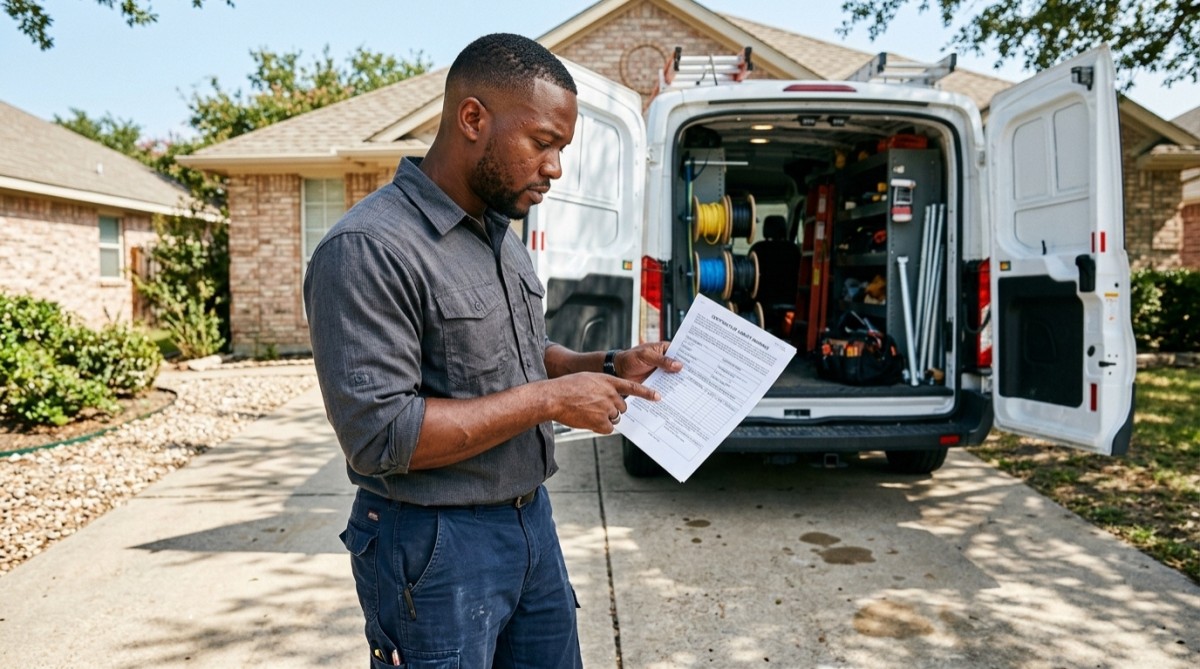
What Does Contractor Liability Insurance Cover?
Bodily Injury to Third Parties
If a client, visitor, homeowner, or bystander is injured because of your work or your operations, bodily injury coverage pays their medical expenses, and if they sue you, it covers your legal defense costs and any resulting settlement or judgment. A homeowner trips on your staging equipment and breaks their ankle. A pedestrian is struck by debris from your roofing operation. A customer walks through a door your crew just reinstalled and it falls. All three are third-party bodily injury claims.
Property Damage Caused by Your Work
If your crew damages property that belongs to someone else during the course of work, property damage coverage pays for the repair or replacement. An electrician accidentally cuts through a plumbing line and causes flooding. A painter knocks over a client's custom lighting fixture. A roofer drops a bundle of shingles onto a neighboring vehicle. A plumber cracks a tile floor during pipe access. These are property damage claims that contractor liability insurance is specifically designed to cover.
Completed Operations Coverage
This is the most financially important and most overlooked component of contractor liability insurance. Completed operations extends your GL coverage to claims that arise after a job is finished and you have left the site.
Contractor work that fails after completion is a constant source of liability exposure. A poorly sealed fitting fails three months after installation and floods a commercial kitchen. A structural repair settles incorrectly and causes cracking six months after project completion. A roofing installation leaks during the first heavy rain. Without completed operations coverage, every one of those delayed claims falls outside your standard GL policy. Completed operations is not an optional add-on. It is a required component of any properly structured contractor GL program.
Personal and Advertising Injury
Contractor GL policies also cover personal and advertising injury claims, including libel, slander, copyright infringement in your advertising, and wrongful eviction. These are less common sources of claims for contractors than bodily injury and property damage, but they are included under the standard CGL form and provide coverage without any additional premium.
Legal Defense Costs
In Texas, even a frivolous lawsuit forces you to hire a lawyer and defend yourself. GL policies pay your legal defense costs in addition to coverage limits, not out of them, on most standard policy forms. If you are sued for $200,000 and your defense costs $40,000, you have not burned $40,000 of your $1 million limit. The defense costs are covered separately. This structure matters significantly when evaluating whether your policy limits are truly adequate for the risk profile of your projects.
What Contractor Liability Insurance Does NOT Cover
Understanding your GL exclusions is as important as understanding your coverage. Knowing what falls outside your GL policy prevents the most common and most expensive coverage gaps for Dallas contractors.
-
Employee injuries. If your employee is injured on the job, that is a workers compensation claim, not a GL claim. GL only covers third-party injuries. Carrying GL without workers compensation leaves your employees unprotected and your business exposed to employee injury lawsuits.
-
Damage to your own work. The GL policy's 'your work' exclusion means it does not cover the cost of repairing or replacing your own defective workmanship. If the tile you installed is crooked and must be replaced, GL does not pay for that. Completed operations cover damage caused by your work, not the remediation of the work itself. Contractor professional liability covers claims that your work was defective in design or specification.
-
Vehicle accidents. Any vehicle accident involving your work trucks or service vehicles is a commercial auto claim, not a GL claim. Even if the accident occurs on a job site or involves a vehicle loaded with tools for a job, GL does not apply.
-
Tools, equipment, and materials. Your GL policy does not cover your own tools, equipment, or materials that are stolen, damaged, or destroyed. An inland marine policy or tools floater covers those assets.
-
Professional advice and design errors. If a client claims that your professional recommendation or design decision caused them financial harm, GL does not cover it. Contractor professional liability (also called contractor's errors and omissions) covers that exposure. Design-build contractors, specialty consultants, and remodeling contractors who provide design input should evaluate professional liability as part of their program.
-
Pollution and environmental damage. Standard GL policies exclude pollution liability. Contractors working with hazardous materials, underground utilities, fuel systems, or environmental cleanup operations need a separate pollution liability policy.
Every exclusion we identify in your policy is an opportunity to evaluate whether an endorsement or additional coverage is warranted for your specific operations.

Per Occurrence vs. Aggregate Limits: What the Numbers on Your Certificate Mean
When a general contractor in Dallas asks for your certificate of insurance, two numbers appear in the GL section: the per occurrence limit and the aggregate limit. Understanding what each means prevents the single most common limit-related coverage surprise in contracting.
The per occurrence limit is the maximum your insurer will pay for any single claim or incident. If your per occurrence limit is $1 million and a client sues you for $800,000 in property damage from a single job site accident, the full claim falls within your per occurrence limit.
The aggregate limit is the total maximum your insurer will pay across all claims during the policy period, typically one year. If your aggregate limit is $2 million and you have three claims totaling $2 million within a year, your policy is exhausted for that policy year regardless of your per occurrence limit.
The standard GL limit structure in the Dallas contractor market is $1 million per occurrence and $2 million aggregate. Most general contractors in DFW require this as the minimum on a subcontractor certificate before awarding work. Larger commercial projects and municipal contracts often require higher limits. We review your bid requirements and ensure your limits meet every contract you are actively pursuing.
Additional Insured Endorsements and Certificates of Insurance for Dallas Contractors
What Is an Additional Insured?
An additional insured endorsement adds another party to your GL policy as a protected party for claims arising out of your work. General contractors in Dallas almost universally require subcontractors to add them as additional insured before starting any job. Commercial property managers require it before allowing work in their buildings. Government entities and municipal clients require it before issuing permits.
When you add a GC as additional insured, their insurer can seek contribution from your GL policy if a claim arises from your work and the GC is also named in a lawsuit. It is a risk-allocation mechanism that protects the party who hired you from bearing the full weight of liability that originated with your work.
Blanket Additional Insured vs. Scheduled Additional Insured
A blanket additional insured endorsement automatically extends additional insured status to any party that your written contract requires you to add. You do not need to name each party individually. Any new contract that requires additional insured coverage is automatically covered as long as a written contract exists.
A scheduled additional insured endorsement requires you to name each specific party. Every new contract requiring additional insured coverage requires a separate endorsement request.
For Dallas contractors working across multiple GC relationships and commercial clients, blanket additional insured coverage eliminates the administrative friction of managing individual endorsements for every new job. We confirm which endorsement form is on your policy at quoting and ensure it matches the language your GC contracts require.
Same-Day Certificates of Insurance
A Certificate of Insurance summarizes your active GL policy: carrier, policy number, coverage types, limits, effective dates, and in most cases certificate holder information and additional insured notation. It is not a policy. It is proof that coverage exists at the moment it is issued.
In the Dallas construction market, COI turnaround time is a competitive differentiator. Missing a bid because your broker takes three days to issue a certificate is a real cost. Our team issues same-day COIs once your coverage is confirmed. We handle additional insured endorsement language, specific wording requirements from your GC contracts, and any certificate holder format your client requests in the same workflow.
How Much Does Contractor Liability Insurance Cost in Dallas?
The GL keyword cluster in Thumann Agency's GSC data shows dozens of cost-related queries as the fastest-improving segment of the site's traffic. This is what Dallas contractors actually want to know. The answer requires a direct and complete response.
Contractor GL premiums in the Dallas market are driven by these primary factors:
-
Trade type and classification code. The GL classification code assigned to your operations determines your base rate per $1,000 of revenue or payroll. Roofing, demolition, and structural work carry the highest rates. Interior finish work, landscaping, and painting carry lower rates. Getting your trade classified correctly at quoting is one of the most important things a broker does.
-
Annual revenue or payroll basis. Most contractor GL policies are rated on annual revenue or payroll. A larger revenue or payroll base produces a higher premium. This also means that as your business grows and revenue increases, your premium at renewal will reflect that growth.
-
Coverage limits selected. The standard $1 million per occurrence/$2 million aggregate structure is the base for most Dallas contractor bids. Higher limits, such as $2 million per occurrence/$4 million aggregate, cost more but are required for certain commercial and municipal contracts.
-
Completed operations inclusion. Some carriers include completed operations automatically in GL. Others charge a separate endorsement premium. Confirming that completed operations is included and adequately sized is part of our quoting process on every account.
-
Claims history. A clean three-year GL loss history is the most effective tool for keeping premiums competitive at renewal. Prior claims, especially bodily injury claims, directly affect your rate and in some cases your carrier eligibility.
-
Experience modification and years in business. Carriers treat established contractors with demonstrated loss experience differently from new contractors entering the market for the first time. A proven track record produces better terms.
For most Dallas tradespeople and small contracting operations, GL-only premiums start well below $2,000 annually for low-risk trades with modest revenue. For higher-risk trades like roofing, structural contractors, and multi-crew general contractors, annual premiums range widely based on revenue, crew size, and project scope. Working with an independent broker who accesses 80+ carriers consistently produces better rates than a single-carrier agent.
Request Your Free Contractor Liability Insurance Quote
Frequently Asked Questions About Contractor Liability Insurance in Dallas
Is contractor liability insurance required by law in Texas?
Texas does not have a single blanket state law requiring all contractors to carry general liability insurance. However, TDLR-licensed trades including electricians and HVAC contractors must carry minimum GL coverage as a condition of licensure. The Texas State Board of Plumbing Examiners requires GL coverage for Responsible Master Plumbers. Many Dallas city permits and municipal contracts require proof of GL coverage. In commercial contracting, every GC requires it from subcontractors and every commercial landlord requires it from tenants before allowing work. The Texas Department of Insurance provides regulatory guidance on Texas insurance requirements. In practice, no Dallas contractor can effectively operate without GL coverage.
What is completed operations coverage and why does every contractor need it?
Completed operations coverage extends your GL policy to claims that arise after a job is finished and you have left the site. Damage from contractor work is frequently discovered weeks, months, or even years after completion. A water line connection that slowly drips behind a wall. An electrical installation that produces a fault months after passing inspection. A roofing application that leaks after the first heavy rain. Without completed operations coverage, those post-job claims fall entirely outside your standard GL policy and you bear them personally. Every Dallas contractor should confirm their GL policy includes completed operations with adequate limits.
Do I need both GL insurance and a surety bond to work as a contractor in Dallas?
For many Dallas contractors, yes. GL insurance and surety bonds serve different purposes and are often both required. GL insurance covers the financial consequences of liability claims. A surety bond guarantees your performance and contractual obligations to the project owner. Public works contracts, City of Dallas permits, and many commercial construction contracts require proof of both. We arrange both and can confirm exactly what your specific project, license, or permit requires.
Do I need workers compensation in addition to GL insurance?
Yes, if you have employees. GL covers third-party injuries. Workers compensation covers your own employees when they are injured on the job. In Texas, workers comp is not mandated for all employers, but opting out removes your common-law defenses in an employee injury lawsuit and leaves you bearing the full financial exposure if a court finds you at fault. Most Dallas GCs and commercial clients also require proof of workers comp before allowing contractors on a job. For any contractor with employees, carrying both GL and workers comp is the standard program structure.
What is an occurrence policy vs. a claims-made policy for contractors?
An occurrence policy covers claims based on when the incident happened, regardless of when the claim is filed. If your 2024 occurrence policy has expired and a client files a claim in 2026 for damage that occurred during a 2024 job, the 2024 policy responds. A claims-made policy covers only claims filed during the active policy period. When a claims-made policy expires, you lose coverage for future claims arising from past work unless you purchase tail coverage. For contractors with completed operations exposure, occurrence policies are the preferred form.
Get Contractor Liability Insurance Structured for Your Dallas Operation
Your reputation, your licenses, and the financial stability of your business depend on having GL coverage that actually fits the work you do. Whether you are a general contractor managing large commercial builds across DFW, a licensed electrician or plumber carrying TDLR or TSBPE compliance requirements, a roofer running crews after North Texas storm events, or a solo tradesperson bidding your first commercial job, Thumann Agency builds a GL program that covers your specific exposure.
Since 1996, we have been the broker Dallas contractors call when they need coverage placed correctly, certificates issued the same day, and a broker who answers the phone when a GC has a question about the wording on the certificate.
Request Your Free Contractor Liability Insurance Quote | Call Us at (972) 991-9100
Last Updated: May 23, 2026
Author: Steve Thumann, Licensed Texas Insurance Broker.
Sources: Texas Department of Insurance, National Association of Insurance Commissioners
Disclaimer: This page is for educational purposes only. Coverage details vary by provider. Contact us for a personalized quote.