Sub Contractors Liability Insurance, Dallas TX

General Liability Insurance for Dallas Subcontractors and Specialty Trade Subs
A general contractor in Frisco awards you a framing subcontract on a multifamily development. Before you can mobilize, they need a certificate of insurance naming them as additional insured, with $1 million per occurrence and $2 million aggregate in GL coverage. Your current policy is in your personal name, the limits are wrong, and the GC will not accept it. You lose the job to the sub who had their certificate ready.
Thumann Agency has been placing insurance for Dallas subcontractors and trade specialists since 1996. As an independent broker with access to 80+ top-rated carriers, we build subcontractor insurance programs around what GCs in the Dallas market actually require: the right limits, the right endorsements, and a certificate issued the same day you need it.
Get a Free Subcontractor Insurance Quote
Why Dallas Subcontractors Choose Thumann Agency
-
80+ Carrier Options so your sub GL gets priced across carriers that understand trade risk, not a single rate
-
Same-Day COI Delivery with correct GC additional insured language, limits, and certificate holder wording issued the day you need it
-
Coverage Built for Your Trade framing, drywall, electrical, plumbing, roofing, concrete, painting, and specialty subs all covered with programs matched to your scope
-
Dallas DFW Construction Market Specialists, Since 1996 who know exactly what North Texas GCs put in subcontract agreements and what they require on a certificate
-
Annual Policy Reviews Included so your limits keep pace as your revenue and project size grow
Why Dallas Tradespeople Trust Us
Thumann Agency has earned 118 client reviews with a 4.7/5 star rating. We hold active BBB Accreditation in Dallas, TX, a Trusted Choice membership, and a 2024 Expertise.com designation as a Top Dallas Insurance Agency. Our clients include trade subcontractors, specialty subs, and construction businesses across DFW who came to us for the coverage and stayed because certificates go out the same day.
“The professional staff has provided nothing but confidence... a long-lasting partnership.” - Betty Maultsby, Larkspur Landscape Design, LLC
“She put together my portfolio in about a week and a half, patiently answered my questions and gave thoughtful guidance. I foresee a long relationship.” - Eric Clendenin, NTX Building Products
“There is a spirit of excellence that seems to run through the company at all levels.” - Cliff Prescott, Fattowels Inc.
“I've been with the agency over 5 years and I've never had a bad experience. My phone calls are always returned in a timely manner.” - Johnerta T., Dallas, TX

What Is Subcontractor Insurance?
Subcontractor insurance is the commercial coverage a subcontractor carries in their own name to protect themselves from third-party liability claims and to satisfy the insurance requirements that general contractors, project owners, and commercial property managers impose before awarding work.
A common misconception: subcontractors assume the general contractor's insurance covers them. It does not. The GC's policy covers the GC's own operations. When a GC requires you to provide a certificate of insurance naming them as additional insured, they are ensuring that your insurance will respond to claims arising from your work, so their own policy is not the first line of defense on losses your crew creates.
Subcontractor insurance is not a specialty product or a separate category. It is standard commercial general liability insurance, potentially combined with workers compensation, commercial auto, and tools coverage, structured and presented in a way that satisfies the specific certificate requirements of the GCs and project owners you work for in the Dallas market.
Why Subcontractors Need Their Own Insurance, Not the GC's
This is the most important concept for any Dallas subcontractor to understand before their next bid.
A general contractor's insurance policy is underwritten based on their specific operations, their employees, their project types, and their risk profile. When a GC adds a subcontractor's work to a job, the GL underwriter is not pricing that sub's risk into the GC's premium on the assumption that the sub has no insurance. The assumption is that each sub carries their own policy.
If a subcontractor has no insurance and causes a loss on a project, the GC's policy may eventually respond, but not before the GC has exhausted significant effort trying to recover from the uninsured sub, and not before the GC's own claims history is affected by a loss that was not their fault. This is precisely why GCs in the Dallas market universally require certificates of insurance from every sub before allowing them on a job site.
Beyond the GC relationship, there are three additional reasons subcontractors need their own coverage:
-
Direct client relationships. Many subs take on work directly from homeowners, commercial tenants, and property owners without a GC intermediary. Those clients have no GC umbrella to rely on. Your own GL policy is the only coverage protecting you in a direct-client job.
-
Completed operations exposure. Your GL exposure does not end when you leave the job site. A drywall sub whose work separates from the framing behind it three months after completion, a plumbing sub whose rough-in has a slow leak discovered after the building is occupied, an electrical sub whose work produces a fault after inspections are passed: completed operations claims fall on you directly, and they require your own policy to respond.
-
Personal asset protection. Operating as an uninsured subcontractor in Dallas means that a $40,000 property damage claim resulting from your work is a personal financial liability with no policy to fund your defense or the settlement. For many solo trade subs, a single uninsured claim can exceed a year of gross revenue.
What Coverage Does a Dallas Subcontractor Need?
General Liability Insurance
GL is the core policy every subcontractor needs. It covers third-party bodily injury and property damage claims arising from your work: a worker from another sub is injured because of unsecured materials your crew left, your crew damages existing systems or finishes on the project, a client claims your work caused damage to adjacent property. GL covers your legal defense costs and any resulting settlement up to your limits.
Standard minimum limits required by Dallas GCs are $1 million per occurrence and $2 million aggregate. Larger commercial projects and institutional work routinely require $2 million per occurrence. We confirm the specific limit requirements of the GCs and project owners you bid to before finalizing your program.
Completed Operations Coverage
Completed operations extend your GL to cover claims arising after you finish your portion of a job and move on. On a construction project with multiple subs, the building may be completed and occupied for months before a deficiency traced to your work surfaces. A concrete sub whose flatwork develops cracking patterns attributed to their mix or finishing. A roofing sub whose flashing installation fails at a specific penetration. An insulation sub whose vapor barrier application leads to moisture issues.
Completed operations are included in properly structured GL policies. Some off-the-shelf or low-cost policies exclude it or impose low aggregate limits on it. We confirm completed operations are included and properly sized on every subcontractor GL policy we place.
Tools and Equipment Coverage
Your tools are the asset that generates your revenue. Hand tools, power tools, specialized trade equipment, and staged materials left at a job site overnight are not covered by your GL policy and are not covered by the GC's property insurance. A break-in that clears your tools from a job site, equipment damaged by another trade's careless operation, or materials stolen from your staging area require your own tools and equipment coverage to fund replacement.
Commercial Auto Insurance
Every vehicle you use to drive to job sites, transport materials, and haul tools is a business vehicle. Personal auto policies exclude business use. If you are involved in an accident driving between job sites in Plano and McKinney and your insurer determines the vehicle was being used for business, they can deny the claim. Commercial auto insurance covers your trucks, vans, and trailers for business-related use and is a standard requirement in most GC subcontractor agreements.
Workers Compensation Insurance
If you bring any crew members to jobs with you, workers compensation insurance is both a practical necessity and a near-universal requirement in GC subcontract agreements. Texas allows employers to opt out, but opting out removes your common-law defenses if an injured crew member sues you. GCs across the Dallas market require proof of workers comp from every sub who brings employees to their job sites, and in many cases Texas law makes the GC responsible for workers comp obligations of uninsured subs working on certain project types.
Commercial Umbrella
When a GC's subcontract requires $5 million in aggregate liability coverage, a commercial umbrella is typically the most cost-effective way to reach that limit. The umbrella provides additional limits above your primary GL, commercial auto, and workers comp policies. For subs competing for larger commercial projects or institutional work across DFW, an umbrella is often the final piece needed to satisfy a high-limit certificate requirement.
Understanding Your Subcontract Insurance Requirements
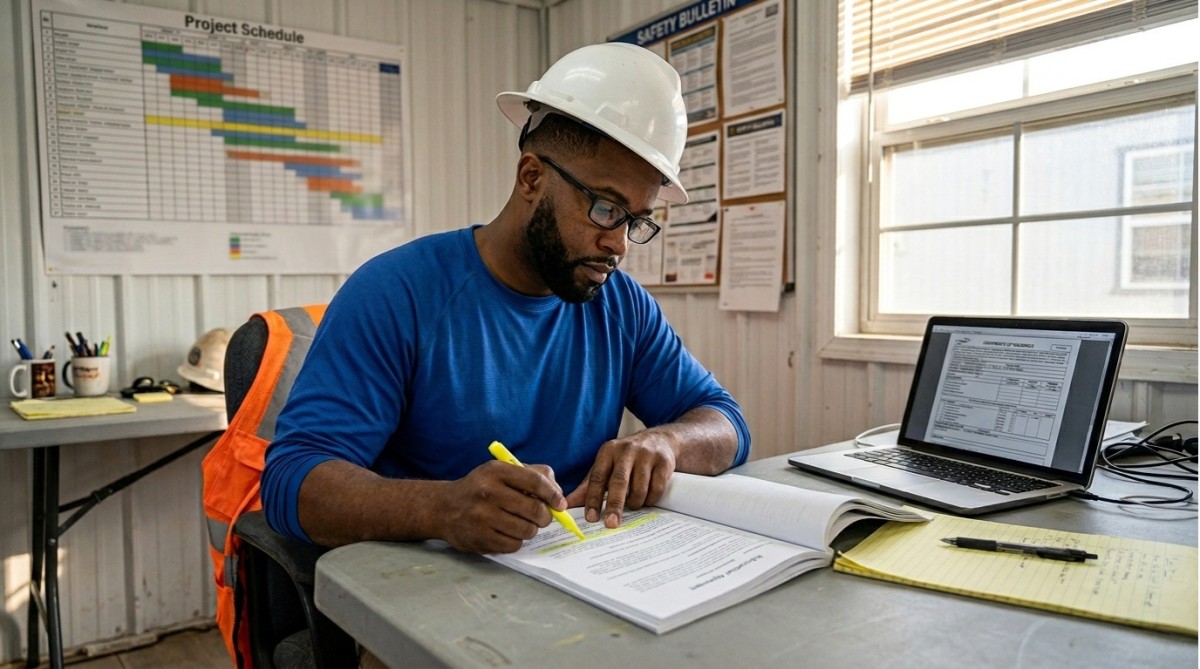
Every subcontract you sign contains an insurance requirements section. Most Dallas subcontractors skim it. Understanding it specifically determines whether your existing policy actually satisfies what you agreed to when you signed.
Additional Insured Endorsements
When your subcontract requires you to add the general contractor as additional insured, you are agreeing to extend your GL coverage to protect them for claims arising from your work. This is not a courtesy. It is a contractual obligation. If you sign a subcontract with an additional insured requirement and your policy does not include that endorsement, you are in breach of the agreement regardless of whether you have GL coverage.
There are two forms. A blanket additional insured endorsement automatically covers any party that a written contract requires you to add, without needing to name each GC individually. A scheduled endorsement requires you to name each GC on the policy. For Dallas subs working across multiple GC relationships simultaneously, a blanket additional insured endorsement is the more efficient structure. We confirm which form is on your policy and whether it matches what your subcontracts require.
Hold-Harmless and Indemnification Clauses
Subcontracts commonly include language requiring you to indemnify the GC against claims arising from your work, and in some cases against claims arising from the GC's own partial negligence. These broad indemnification clauses can obligate you to defend and indemnify losses that your standard GL policy may not fully cover.
Indemnification clauses that include the GC's own negligence, that waive certain coverage defenses, or that impose unlimited liability exposure can create gaps between what you contractually agreed to and what your policy will actually pay. We review indemnification language in subcontracts as part of our coverage consultation for Dallas subs working on complex commercial projects, and we flag provisions that may require coverage adjustments before you sign.
Waiver of Subrogation
Many GC subcontracts require a waiver of subrogation endorsement on your policy. This means that if your insurer pays a claim and would normally have the right to pursue the GC to recover that payment, your policy endorsement waives that right. The GC is asking you to ensure your insurer cannot come after them after paying a claim. Most GL policies can include this endorsement, but it must be specifically requested and confirmed before your certificate is issued.
How Much Does Subcontractor Insurance Cost in Dallas?
Subcontractor GL premiums are calculated based on your trade classification, annual revenue, and the limits you carry. As an independent broker shopping 80+ carriers, we produce competitive pricing by making carriers compete for your program rather than applying a single rate.
Key cost factors for Dallas subcontractors:
-
Trade classification. Your GL premium starts with your trade's base rate per $1,000 of revenue. Roofing and structural work carry higher base rates than painting or finish work. Getting your classification right matters because an incorrect classification can produce a premium based on the wrong rate entirely.
-
Annual revenue. GL premiums scale with revenue. A solo sub billing $150,000 per year pays significantly less than a crew of eight billing $1.5 million on the same trade classification.
-
Limits selected. Standard $1 million/$2 million GL limits are the Dallas market baseline. Higher limits for commercial projects, an umbrella to reach $5 million or more, or per-project limit endorsements add to the base premium.
-
Completed operations aggregate. How your completed operations limit is structured affects premium. Some carriers provide the full aggregate for completed operations; others cap it separately. We confirm the structure at quoting.
-
Workers comp payroll. If you have crew members, workers comp premium is calculated directly from payroll by job class code. Roofing and structural trades carry higher workers comp rates than interior finish trades.
-
Claims history. A clean three-year GL history is the most effective cost management tool available. Prior claims affect your rate and in some cases your carrier eligibility.
Subcontractors who want to review their full program including GL, commercial auto, workers comp, and tools as one coordinated structure can also review our complete contractors insurance program which covers the full range of contractor coverages for Dallas trade businesses operating at any scale.
Request Your Free Subcontractor Insurance Quote
Frequently Asked Questions About Subcontractor Insurance in Dallas
Does the GC's insurance cover me as a subcontractor?
No. The general contractor's insurance covers the GC's own operations and employees. It does not extend to your crew, your work, or your completed operations. When a GC requires a certificate of insurance from you, they are specifically requiring that you carry your own policy. If you cause a loss on a project and have no insurance, the GC's policy may eventually be drawn in, but it will not protect you personally from the financial exposure, and it will not protect you from a claim made against you directly by the project owner or an injured third party.
What is an additional insured endorsement and why do GCs require it?
An additional insured endorsement adds the general contractor to your GL policy as a protected party for claims arising from your work. GCs require it because if your work causes a loss and the project owner names the GC in a lawsuit alongside you, the GC wants your insurance to step in to defend them rather than relying solely on their own policy. It is a standard risk-allocation mechanism in every DFW subcontract agreement. We add the endorsement and issue the updated certificate the same day.
Do subcontractors need a license to work in Texas?
It depends on the trade. Texas does not require a general contractor license at the state level, but individual licensed trades including electrical, HVAC, and plumbing require a Texas Department of Licensing and Regulation license or, for plumbing, a Texas State Board of Plumbing Examiners license. Performing licensed-trade work without the required license creates both regulatory and insurance exposure: some GL carriers exclude claims from work performed illegally. Dallas and other DFW municipalities also have local registration requirements for certain trade categories.
What limits do Dallas GCs typically require from subcontractors?
The standard in the Dallas market is $1 million per occurrence and $2 million aggregate for GL. Larger commercial projects and institutional work frequently require $2 million per occurrence. Some GC agreements require a commercial umbrella to achieve a $5 million or higher total aggregate. We review your specific subcontract requirements and confirm your program satisfies them before issuing the certificate.
How quickly can I get a Certificate of Insurance for a GC requirement?
Same day in most cases. If you have a subcontract in hand and need a compliant COI by the end of the day to make a mobilization date, call us. We issue certificates with the correct GC additional insured language, limits, waiver of subrogation notation, and any specific certificate holder wording required by the GC's compliance team in the same request.
Get Subcontractor Insurance Built for Your Dallas Trade Business
Whether you are a solo framing sub competing for residential projects in Frisco and McKinney, a specialty electrical or plumbing sub working commercial builds across Uptown and the Design District, or a growing drywall operation building GC relationships across the DFW construction market, your subcontractor insurance program needs to satisfy what GCs actually require, not what a generic online policy provides.
Since 1996, Thumann Agency has been the broker Dallas trade subs call when they need coverage placed correctly, certificates issued the same day a GC asks for them, and a broker who understands what is in a DFW subcontract agreement before they write the policy.
Request Your Free Subcontractor Insurance Quote | Call (972) 991-9100
Last Updated: June 07, 2026
Author: Steve Thumann, Licensed Texas Insurance Broker.
Sources: Texas Department of Insurance, National Association of Insurance Commissioners
Disclaimer: This page is for educational purposes only. Coverage details vary by provider. Contact us for a personalized quote.