

Home insurance in Texas costs more than it does in many parts of the country, but there is no single average that accurately predicts what every homeowner will pay. Your location, rebuilding cost, roof, deductible, claims history and selected coverage can all make a substantial difference.
In this guide, we explain what current Texas home insurance figures really mean, why published averages differ and which factors are most likely to affect your premium.
How Much Is Home Insurance in Texas in 2026?
In brief: The latest Texas Department of Insurance data puts the statewide average at approximately $3,489 per year, but many homeowners may pay between $3,500 and $6,000 or more depending on their home, location and coverage.
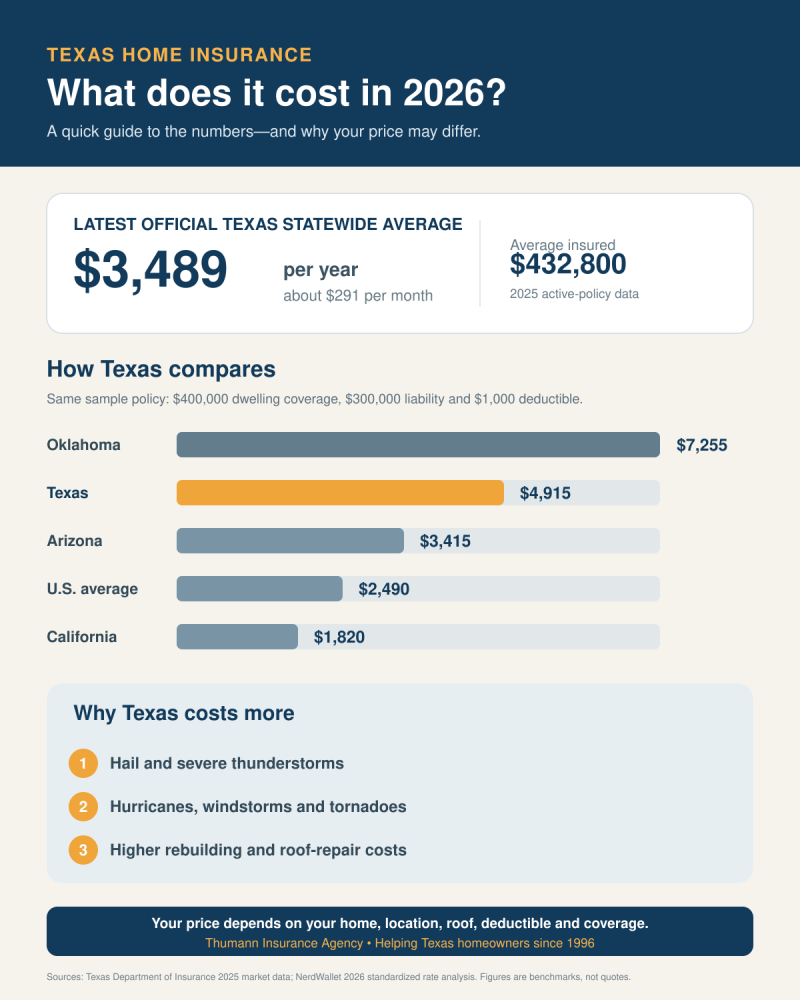
A reasonable starting point for the average cost of homeowners insurance in Texas is approximately $3,489 per year, based on the latest available data for active policies collected by the Texas Department of Insurance.
That statewide average includes homes with different rebuilding costs, policy limits, deductibles and risk characteristics. The average insured property amount in the same dataset was approximately $432,800, so the figure should not be presented as the cost of a standardized policy with $300,000 in dwelling coverage.
Published sample-rate studies produce different results because they use specific customer and policy assumptions. For example, one 2026 analysis estimated the following average Texas rates:

These examples assume good credit, no recent claims, a $1,000 deductible and $300,000 in liability coverage. A homeowner with a different roof, deductible, ZIP code, claims record or coverage package could receive a considerably different price.
The most honest answer is that many Texas homeowners may pay approximately $3,500 to $6,000 per year, while some will fall below or above that range. The only reliable way to determine the cost for a particular home is to review the property and obtain quotes based on the coverage actually required.
Important note: Dwelling coverage is based on the estimated cost of rebuilding your home - not its sale price, purchase price or current market value.
How Does the Cost of Home Insurance in Texas Compare With Other States?
In brief: Using the same sample policy, Texas averages approximately $4,915 per year, compared with a national average of $2,490. Texas is expensive - but neighboring Oklahoma costs even more.
To make a fair comparison, the figures below use the same sample customer and policy: a 40-year-old homeowner with good credit, $400,000 in dwelling coverage, $300,000 in liability coverage and a $1,000 deductible.

Under these assumptions, Texas home insurance costs approximately 97% more than the national average. Texas homeowners pay considerably more than homeowners in states such as Arizona and California, although neighboring Oklahoma is even more expensive.
Weather exposure is one of the biggest reasons for these differences. Texas is vulnerable to hail, tornadoes, severe thunderstorms, hurricanes, flooding, wildfires and winter freezes. The combination of frequent property damage and rising rebuilding costs influences what insurers charge.
State comparisons need context. A lower advertised premium does not always mean identical protection. Some states or high-risk areas may require separate wind, hurricane or flood coverage, and policy terms, deductibles and exclusions vary. These figures are useful benchmarks - not predictions of what an individual homeowner will pay.
Why Is Home Insurance So Expensive in Texas?
In brief: Texas premiums are affected by hail, severe storms, hurricanes, tornadoes, wildfires, freezes and rising rebuilding costs. Insurers charge more where claims are frequent or expensive.
Texas homeowners face several major risks at once. Hail and severe thunderstorms affect North Texas, hurricanes and windstorms threaten coastal communities, and other parts of the state experience tornadoes, wildfires, flooding and winter freezes. Insurers consider both how likely a loss is and how expensive the resulting repairs may be.
Hail and severe storms
Hail is one of the most significant causes of property damage in Texas. Texas Department of Insurance data shows that hail produced approximately $4.93 billion in insured homeowners losses during 2024, making it the largest recorded category of homeowners losses that year.
This is particularly relevant in Dallas and North Texas, where repeated hailstorms can damage roofs, siding, windows and outdoor structures. A property's roof age, material and condition can therefore materially affect its premium and eligibility with certain carriers.
Hurricanes and coastal wind exposure
Homes near the Texas coast face increased exposure to hurricanes and tropical storms. In some designated coastal areas, a standard homeowners policy may not include wind and hail coverage. Homeowners may need separate protection through the Texas Windstorm Insurance Association or another available provider.
Rising rebuilding costs
Home insurance is based primarily on the estimated cost of rebuilding - not the home's market value. When the cost of construction materials, skilled labor and building services rises, insurers must account for the increased amount required to repair or reconstruct damaged homes.
Higher coverage amounts
The average amount of homeowners coverage in Texas increased from approximately $294,900 in 2020 to $432,800 in 2025. Even without a change in the underlying insurance rate, higher rebuilding estimates can increase the final premium because more property value is being insured.
Recent claims and catastrophe losses
Texas has experienced substantial insured losses from hail, wind, freezing temperatures, fire and water damage. Statewide homeowners premiums rose sharply during 2022, 2023 and 2024, although the average filed rate increase slowed considerably during 2025.
For homeowners, this means a renewal increase may reflect more than an individual claim or a change to the home. It may also reflect updated rebuilding estimates, changing weather risk and a carrier's recent loss experience in that area.
How Home Insurance Costs Vary Across Texas
In brief: Location matters. Sample rates are generally higher in Dallas, Fort Worth and Houston than in Austin or San Antonio because weather exposure and claims patterns differ throughout the state.
Where you live can make a substantial difference to the cost of homeowners insurance. Insurers consider local weather exposure, historical claims, rebuilding costs, fire protection, crime and the individual characteristics of the property.
One 2026 analysis, based on a sample policy with $400,000 in dwelling coverage, estimated the following average costs:

These figures show why a single statewide average cannot accurately represent every Texas homeowner. In this analysis, the estimated premium in Houston was more than twice the estimated premium in Austin - even though the same basic customer and coverage assumptions were used.
Dallas and North Texas
Homeowners in Dallas, Fort Worth and surrounding communities may face higher premiums because of the region's exposure to hail, severe thunderstorms, high winds and tornadoes. Roof age and condition can be particularly important when an insurer decides whether to offer coverage and at what price.
Two similar homes in Plano, Frisco, Little Elm or Dallas can still receive very different quotes. Construction type, replacement cost, roof material, claims history, deductible and the carrier's appetite for that ZIP code can all affect the result.
Houston and the Gulf Coast
Houston and coastal communities can face higher costs because of hurricanes, tropical storms, flooding and wind exposure. Some homes in designated coastal areas may need separate windstorm coverage, while flood insurance is normally purchased separately from a standard homeowners policy.
Central and West Texas
Austin and San Antonio may have lower sample averages than parts of North Texas and the Gulf Coast, but local wildfire exposure, hail, construction costs, water losses and individual property characteristics can still affect premiums.
West Texas homeowners may face wind, hail, wildfire and limited access to emergency services in some rural areas. Distance from a fire station or hydrant can also influence how an insurer assesses a property.
Why your ZIP code isn't the whole story
Location matters, but it is only one part of the calculation. Even neighbors can pay different amounts when their homes have different rebuilding costs, roofs, deductibles, coverage endorsements or claims histories.
The city figures above should therefore be treated as general comparisons - not quotes or guaranteed rates. The most reliable estimate will always come from reviewing the individual home and the protection required.
What Affects the Cost of Home Insurance in Texas?
In brief: The biggest factors include rebuilding cost, ZIP code, roof age, claims history, deductible and selected coverage. Even neighboring homes can receive very different quotes.
Insurance companies consider a combination of property, location, coverage and customer information when calculating a homeowners premium. Although each carrier uses its own underwriting rules, the following factors commonly have the greatest effect.
Your home's rebuilding cost
Dwelling coverage should reflect what it would cost to rebuild the home using current materials and labor - not its market value or the amount you paid for it. Larger homes and properties with custom finishes or specialist materials generally require higher coverage limits.
Your location
Insurers examine local weather losses, coastal or wildfire exposure, construction costs, fire protection, crime and property-claim patterns. Location can also affect which carriers are willing to insure the home.
Roof age, condition and material
Because of frequent hail and wind claims, insurers may examine roof age, condition, material, building standards, previous damage and whether claims are settled using replacement cost or depreciated value.
Your deductible
A higher deductible may reduce the premium, but it increases the amount you must pay following a covered loss. Texas policies may have separate percentage-based deductibles for wind, hail or named storms.
Your claims history
Insurers may consider claims associated with the customer and the property. The type, frequency and timing of previous claims may affect both price and carrier availability.
Your coverage selections
Dwelling, belongings, liability, replacement-cost terms and optional endorsements all influence the premium. Removing coverage may reduce price but can transfer considerably more financial risk to the homeowner.
Insurance history and credit information
Insurers may consider previous coverage, payment history and credit-based insurance information where permitted. Maintaining continuous coverage and accurate property information can help avoid underwriting complications.
Discounts and protective features
Available discounts vary by carrier, but potential savings may be available for:
- Combining home and auto insurance
- Monitored fire or security systems
- Water-leak detection or automatic shut-off devices
- Impact-resistant roofing
- Updated electrical, plumbing or heating systems
- Being claims-free
- Paying the policy in full
Discounts should be viewed as one part of the decision. The coverage, deductible and claim settlement terms remain more important than the discount percentage alone.
How Wind and Hail Deductibles Work in Texas
One of the most important parts of a Texas homeowners policy is the wind and hail deductible. It determines how much you must pay before the insurance company contributes toward a covered wind or hail claim.
Many policies use a separate wind and hail deductible instead of applying the standard deductible shown elsewhere in the policy. It may be expressed as a percentage of the home's dwelling coverage - not as a percentage of the total claim.

If a covered hailstorm caused $15,000 of roof damage and the policy carried a 2% wind and hail deductible, the homeowner would be responsible for the first $8,000. The insurer would then consider the remaining covered amount, subject to the policy's terms, limits and method of settling the roof claim.
Questions to ask about the deductible
- Is the wind and hail deductible a fixed amount or a percentage?
- Which dwelling limit is used to calculate it?
- Does it apply to each separate claim?
- Is there a different deductible for named storms or hurricanes?
- Is roof damage settled at replacement cost or actual cash value?
- Are cosmetic hail losses restricted or excluded?
- Are there special roof-payment schedules or age-related limitations?
Replacement cost versus actual cash value
Replacement-cost coverage generally considers the cost of replacing damaged property with comparable new materials, subject to the policy conditions. Actual cash value accounts for age and depreciation, which means an older roof could receive a substantially lower claim payment than the cost of installing a new one.
Some insurers provide replacement-cost coverage initially but change the roof settlement terms as the roof ages. Homeowners should review endorsements and renewal documents rather than assuming the roof continues to be covered in the same way every year.
The cheapest policy may create the largest surprise
A quote can look attractive because it includes a higher percentage deductible or more restrictive roof coverage. These differences may not feel significant until a hailstorm produces a major claim. The objective should be to choose a deductible and roof-coverage arrangement that protects the home while remaining financially manageable after a loss.
How Roof Age Affects Home Insurance in Texas
Your roof's age and condition can have a significant effect on the cost and availability of home insurance in Texas. Because hail and high winds produce frequent roof claims, insurers examine roofs carefully when deciding whether to offer coverage and how a future claim would be settled.
Why insurers ask about the roof
A newer, well-maintained roof is generally more likely to withstand severe weather than an older roof with worn materials or existing damage. An insurer may ask when the roof was installed, which material was used, whether the entire roof was replaced, whether permits or invoices are available, and whether there is previous damage.
Older roofs may have fewer coverage options
There is no single roof-age rule followed by every insurance company. Depending on age and condition, a carrier may charge more, apply a larger wind and hail deductible, offer actual-cash-value roof coverage, use a payment schedule, require repairs or decline the property.
This is one reason access to multiple carriers can be valuable. A home that does not meet one insurer's guidelines may still qualify elsewhere, although the coverage and price must be reviewed carefully.
Documentation can help
If your roof has recently been repaired or replaced, retain:
- The contractor's invoice
- Installation date
- Material and manufacturer information
- Warranty documentation
- Permit or inspection records
- Before-and-after photographs
- Any impact-resistance certification
A new roof does not guarantee a lower premium
Replacing an aging roof may improve the home's insurability and could qualify for certain credits, but it does not guarantee that the overall premium will decrease. Location, rebuilding cost, claims history, deductible and the carrier's current rates will still affect the final price.
How to Lower Home Insurance Costs Without Sacrificing Important Coverage
In brief: Review the policy early, explore suitable carrier options, check discounts and choose a manageable deductible. Don't reduce important coverage solely to obtain a cheaper premium.
Reducing the cost of home insurance should begin with a careful policy review - not simply removing coverage or selecting the largest available deductible.
Review your policy before renewal
Start several weeks before renewal so there is time to confirm property information, understand any increase and consider alternatives without making a rushed decision.
Review several suitable carrier options
Insurance companies assess Texas properties differently. Examine the premium alongside deductibles, roof terms, limits, exclusions, endorsements, financial strength and claims service.
Choose a deductible you can realistically afford
A higher deductible may reduce the premium, but the saving should be meaningful enough to justify the additional amount you would pay after a loss.
Ask about available discounts
Ask which discounts or credits have actually been applied for bundling, protective systems, leak detection, impact-resistant roofing, updated systems or paying annually.
Understand the numbers before filing a small claim
For a relatively minor loss, compare the estimated repair cost with the applicable deductible and speak with the agency about how the policy works. This does not mean avoiding a legitimate claim.
Protect the home against preventable losses
Maintain the roof and gutters, trim trees, repair leaks, protect pipes during freezes, install water-detection devices and document the home and belongings.
Review coverage - not just price
The goal is to remove unnecessary costs, identify available credits and choose suitable terms - not leave the property underinsured.
For a more detailed checklist, read our guide to saving on homeowners insurance without cutting essential coverage.
How Much Home Insurance Coverage Do You Need?
In brief: Insure the home for its estimated rebuilding cost - not its purchase price or market value. Also review belongings, liability, living expenses and risks requiring separate coverage.
The amount of home insurance you need should be based on the potential financial loss - not simply the minimum required by a mortgage lender or the current market value of the property.
Dwelling coverage
This protects the physical structure against covered damage. The limit should reflect rebuilding with comparable materials at current local prices, including demolition, debris removal, labor, permits and applicable building-code changes.
Extended replacement-cost protection
Construction costs can rise after a widespread storm. Extended replacement-cost coverage may provide an additional percentage above the dwelling limit when a covered loss costs more than expected.
Personal-property coverage
This protects belongings such as furniture, clothing and electronics. A home inventory can help determine an appropriate limit, while valuable items may require additional scheduled coverage.
Other structures
Detached garages, fences and sheds are generally insured separately within the policy. Homeowners with substantial detached buildings should check the automatic limit.
Additional living expenses
This may help pay extra accommodation, food and other necessary expenses if a covered loss makes the home temporarily uninhabitable.
Personal liability
This helps protect the homeowner if legally responsible for injury or property damage. Assets and exposures such as pools, dogs, visitors, rental activity and home businesses should be considered.
Coverage that may need to be purchased separately
- Flooding
- Coastal windstorm exposure
- Water or sewer backup
- Earth movement
- Equipment breakdown
- Service lines
- Home-business activities
- Valuable personal property
The right coverage is not determined by one formula. It requires an individual review of the home, belongings, liabilities and risks the household could not comfortably absorb itself.
Frequently Asked Questions About Home Insurance Costs in Texas
In brief: Texas home insurance prices vary widely. Your property, location, roof, deductible and coverage are more useful predictors than a statewide average.
-
How much is home insurance in Texas per month?
The latest Texas Department of Insurance data shows an average annual homeowners premium of $3,489, which is approximately $291 per month. This statewide figure includes properties with different coverage amounts and risk characteristics.
-
Why is homeowners insurance so expensive in Texas?
Texas faces numerous property risks, including hail, high winds, severe thunderstorms, tornadoes, hurricanes, wildfires, flooding and winter freezes. Rising labor and material costs have also made covered repairs and rebuilding more expensive.
-
Is home insurance required in Texas?
Texas law does not require homeowners to carry home insurance. However, a mortgage lender will normally require coverage while there is an outstanding loan on the property.
-
Does Texas home insurance cover flooding?
Standard homeowners insurance generally does not cover flooding caused by rising surface water. Separate flood insurance may be available through the National Flood Insurance Program or a private insurer.
-
Why are home insurance quotes so different?
Each insurer uses its own rates, underwriting rules and risk preferences. Quotes may also contain different deductibles, roof-settlement terms, exclusions and endorsements, so price should be reviewed alongside protection.
-
Does an older roof make home insurance more expensive?
It can. An older roof may result in a higher premium, fewer available carriers, a larger deductible or actual-cash-value claim settlement. There is no universal roof-age rule across all insurers.
-
How often should I review my homeowners insurance?
Review it at least once a year and after renovations, a roof replacement, major purchases, new structures, home-business activity or a substantial premium increase.
-
Can an independent insurance agency help lower the cost?
An independent agency can review suitable options from multiple carriers. This does not guarantee a lower price, but it can help identify meaningful differences in premiums, deductibles, coverage and underwriting requirements.
Why Texas Homeowners Choose Thumann Insurance Agency
In brief: Thumann Insurance Agency has helped Texas homeowners since 1996. As an independent agency with access to more than 80 carriers, we help clients understand their options and choose coverage suited to their home and circumstances.
Home insurance involves more than obtaining a price. The deductible, roof-settlement terms, exclusions and optional coverages can make a substantial difference when a homeowner needs to make a claim. Thumann Insurance Agency takes the time to understand the property and explain the meaningful differences between available options.
Independent advice
Thumann is an independent insurance agency rather than a representative of one insurance company. This allows our team to review appropriate options from our network of more than 80 carriers. Not every carrier will be suitable for every property, so we focus on options that fit the home's characteristics, location and coverage needs.
Texas experience since 1996
Our team understands North Texas hail and windstorms, roof-related underwriting, coastal and hurricane exposure, flooding concerns, rising rebuilding costs, percentage-based deductibles and the needs of high-value and custom homes.
Clear explanations without pressure
We help homeowners understand what the policy covers, which deductible applies, how roof claims may be settled, whether important exclusions apply and which additional protections may be appropriate. The final decision belongs to the homeowner; our role is to provide clear information and experienced guidance.
Request a Texas Home Insurance Review
If your premium has increased or you are unsure whether your current policy still provides suitable protection, our team can review it with you.
Whether you are buying a home, approaching renewal or concerned about a significant premium increase, Thumann Insurance Agency can help you understand your current coverage and explore appropriate options.
Request a homeowners insurance review
Call our team: (972) 991-9100
There is no obligation to change your policy. We will help you understand the coverage, deductibles and available options so you can make an informed decision.
Last Updated: September 25, 2026
Author: Lauren Thumann Director of Marketing.

Sources and editorial notes
Texas Department of Insurance - Texas homeowners insurance market overview
Texas Department of Insurance - Home insurance guide
Texas Department of Insurance - Auto and home insurance rate changes
NerdWallet - Average homeowners insurance costs for 2026
NerdWallet - Texas home insurance analysis
**Pricing figures are benchmarks, not quotes. They should be reviewed periodically because insurance rates, underwriting requirements and published datasets change.